Home Storage Plans
Plans
New plans in this category are being prepared. Browse all free woodworking plans in the meantime.
Plan storage around what it will hold
Measure what goes inside before you choose a plan. Shoes need about 12 in (30 cm) of depth, most books 10–12 in (25–30 cm), and kitchen pantry shelves are easiest to use at 12–16 in (30–40 cm) deep. Leave a little extra height between shelves so items lift out easily.
Mounting to the wall
Wall storage is only as strong as its fixing. Screw into wall studs wherever you can; use a stud finder and mark them before you build so the cleat or back rail lines up. For drywall without a stud, use anchors rated for the weight. Floating shelves need a strong hidden bracket or cleat screwed into studs.
Tall, free-standing storage such as bookcases and cabinets should be fixed to the wall with an anti-tip kit.
Materials for storage builds
Plywood is stable and strong for shelves and cabinet boxes; cover exposed edges with edge banding or thin solid-wood strips. Pine boards are good for open shelving and benches. For painted built-ins, MDF gives a smooth finish but is heavy and does not hold screws in its edges well.
Room ideas
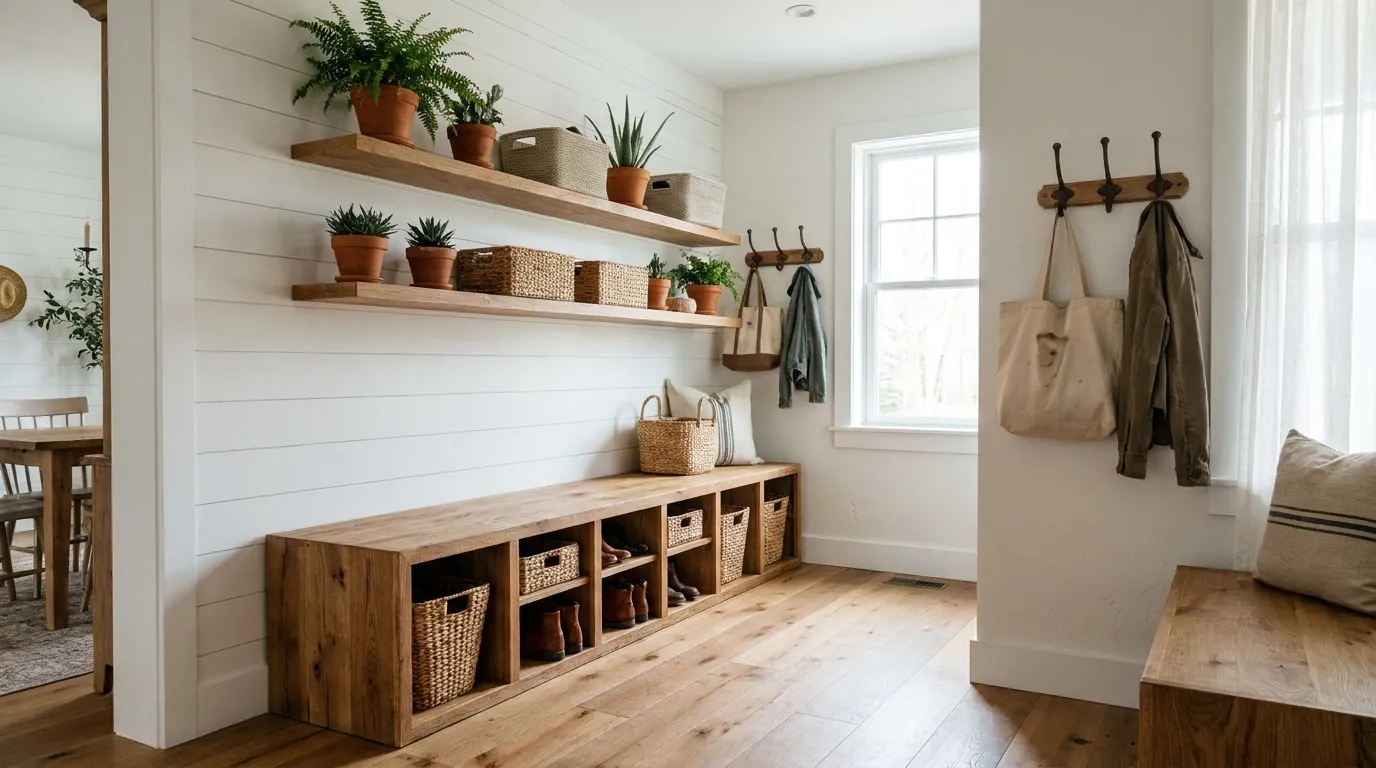
- Entryway: a bench with shoe cubbies and hooks above
- Closet: adjustable shelves and hanging rails
- Kitchen and pantry: shallow shelves so nothing hides at the back
- Laundry: a shelf above the machines and a folding counter
For freestanding pieces, see our furniture plans. For the garage, see our workshop plans.
Frequently asked questions
How deep should storage shelves be?
10–12 in (25–30 cm) for books and most household items, about 12 in (30 cm) for shoes, and 12–16 in (30–40 cm) for pantry shelves.
How do I hang heavy shelves safely?
Screw the bracket or cleat into wall studs. Where there is no stud, use wall anchors rated for more than the expected load.
Is plywood or MDF better for shelves?
Plywood is stronger, lighter and holds screws better. MDF paints very smoothly but sags more and is heavy.
What is a French cleat?
Two strips of wood cut at a 45° angle: one is screwed to the wall, the other to the back of a shelf or cabinet. They hook together, hold heavy loads and let you move items easily.